The Kailash Mansarovar Yatra via Nathu La Pass in Sikkim is one of the most significant pilgrimage journeys organised by the Ministry of External Affairs (MEA), Government of India. This official route provides Indian pilgrims with an opportunity to visit the sacred Mount Kailash and Lake Mansarovar through the beautiful Himalayan state of Sikkim and the Nathu La border crossing into Tibet.
- For millions of devotees of Lord Shiva, visiting Mount Kailash is a lifelong dream. Believed to be the divine abode of Lord Shiva and Goddess Parvati, Mount Kailash holds immense religious importance in Hinduism, Buddhism, Jainism and the Bon religion. The nearby Lake Mansarovar is equally sacred and is associated with spiritual purification and divine blessings.
- Unlike the Lipulekh route in Uttarakhand, which involves considerable trekking, the Nathu La route offers a largely road-based journey across Sikkim and the Tibetan plateau. This makes it a comparatively convenient option for pilgrims who prefer travelling by vehicle for most of the journey, although the high-altitude conditions and Kailash Parikrama still require physical fitness and medical preparation.
- In this complete guide by Kailash Mansarovar Himalayas, we explain the Nathu La route, government registration procedure, eligibility, travel itinerary, expenses, medical requirements and important preparations for this sacred pilgrimage.
What Is the Kailash Mansarovar Yatra via Nathu La Pass?
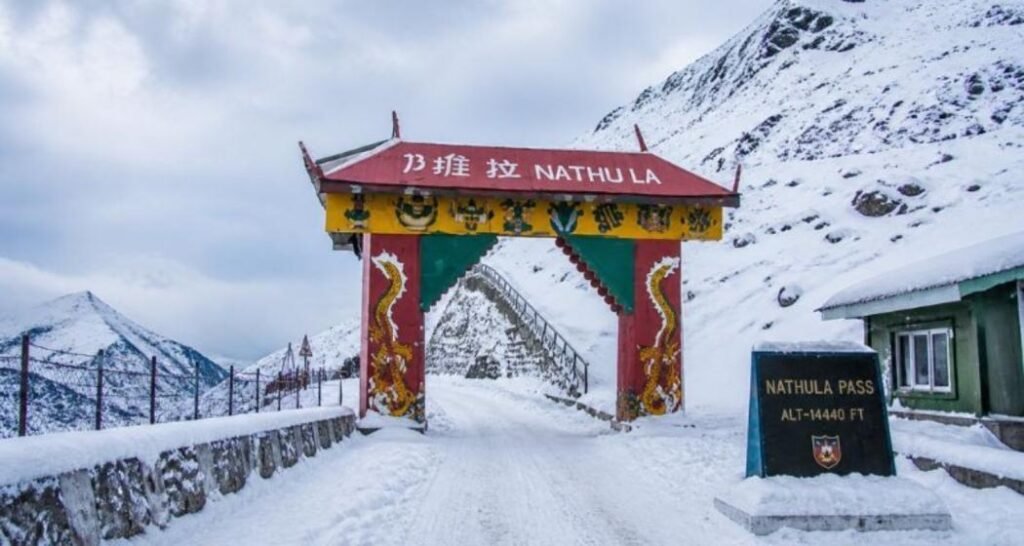
- Nathu La is a high-altitude mountain pass situated in the eastern Himalayan region of Sikkim, connecting India with Tibet. It serves as the entry point for the official Government of India Kailash Mansarovar pilgrimage through Sikkim.
- The Nathu La route was introduced in 2015 as an additional official route for the Kailash Mansarovar Yatra. The pilgrimage is organised by the Ministry of External Affairs in coordination with the Government of Sikkim, the Sikkim Tourism Development Corporation (STDC), the Indo-Tibetan Border Police and the concerned Chinese authorities.
- The route is particularly notable because most of the journey from Sikkim to the Kailash region is completed by road. Pilgrims also receive organised assistance, medical examinations, accommodation and transportation as part of the government-arranged programme.
- Important: The Nathu La Pass pilgrimage is an official Government of India programme. Private travel agencies cannot independently organise or issue bookings for this specific MEA route. Applications must be submitted through the official government portal.
Why Choose the Nathu La Route for Kailash Mansarovar Yatra?
There are several reasons why pilgrims consider the Sikkim route an attractive option.
- Mostly Motorable Journey: Unlike the traditional Lipulekh approach, the Nathu La route involves substantially less trekking before reaching the Kailash region.
- Government Organisation: The pilgrimage is conducted under the supervision of the Ministry of External Affairs.
- Organised Medical Facilities: Pilgrims undergo prescribed medical examinations before proceeding to higher elevations.
- Acclimatisation Arrangements: The programme includes designated halts to help pilgrims adjust to high-altitude conditions.
- Scenic Himalayan Landscapes: Travellers experience the natural beauty of Sikkim, mountain valleys and the Tibetan plateau.
- Religious Experience: The journey includes visits to Lake Mansarovar and the opportunity to undertake the sacred Kailash Parikrama.
Although the road-based approach is comparatively convenient, it should not be considered an easy holiday tour. The high altitude, long road journeys and strenuous Parikrama demand proper preparation.
Kailash Mansarovar Yatra via Nathu La Route Map
The official pilgrimage generally begins in Delhi, followed by a flight to Bagdogra and a road journey to Gangtok. Pilgrims then proceed towards the designated acclimatisation locations near Nathu La before crossing the India–Tibet border.
Major Route:
💫Delhi → Bagdogra → Gangtok → 15th Mile → Sherathang → Nathu La Pass → Kangma → Lazi → Zhongba (Dongba) → Darchen → Mount Kailash → Lake Mansarovar → Return via Nathu La → Gangtok → Bagdogra → Delhi.
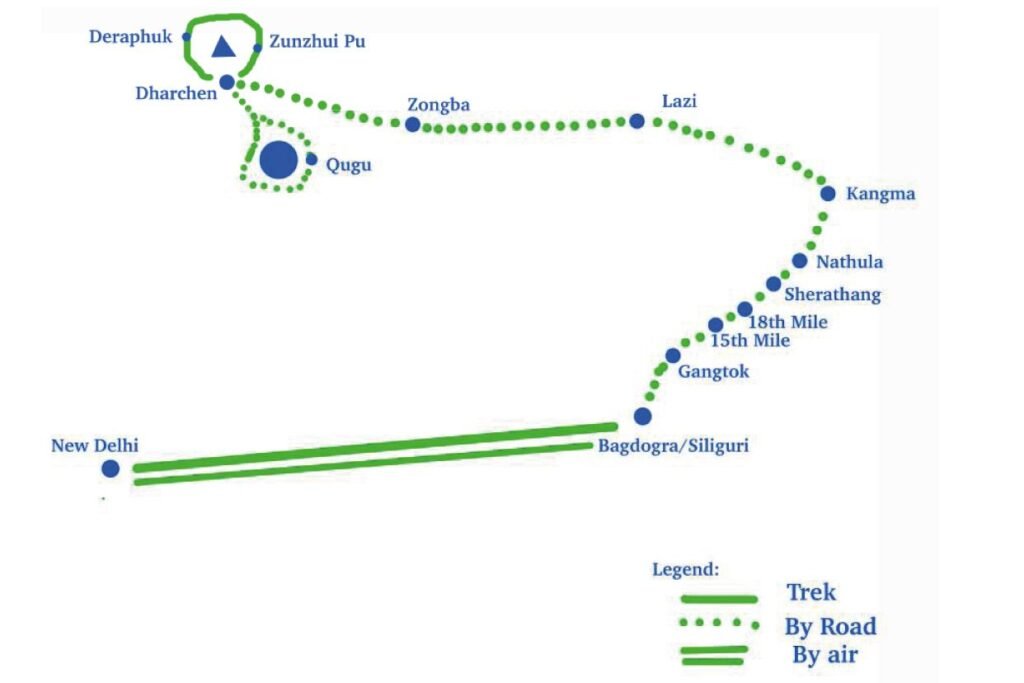
The exact halts and sequence can change according to the official annual itinerary.
Complete Travel Itinerary – Kailash Mansarovar Yatra via Nathu La
The Government of India generally plans the Nathu La pilgrimage over approximately 18 days in its published day-to-day travel schedule, with additional reporting, medical and documentation formalities in Delhi. The overall programme is commonly around 22–23 days, depending on the annual schedule.
The following is a simplified illustrative itinerary, not a confirmed departure programme.
| Day | Travel Programme | Overnight Stay |
|---|---|---|
| Day 1 | Arrival in Delhi and reporting at the designated accommodation | Delhi |
| Day 2 | Medical examination and passport-related formalities | Delhi |
| Day 3 | ITBP medical examination | Delhi |
| Day 4 | MEA briefing, documentation and preparation | Delhi |
| Day 5 | Flight from Delhi to Bagdogra and drive to Gangtok | Gangtok |
| Day 6 | Drive from Gangtok towards 15th Mile | 15th Mile |
| Day 7 | Rest and acclimatisation | 15th Mile |
| Day 8 | Drive to Sherathang | Sherathang |
| Day 9 | Medical examination and acclimatisation | Sherathang |
| Day 10 | Cross Nathu La Pass and enter Tibet | Tibet |
| Day 11 | Continue towards Lazi | Lazi |
| Day 12 | Drive towards Zhongba | Zhongba |
| Day 13 | Continue towards Darchen, the base of Mount Kailash | Darchen |
| Day 14 | Begin Kailash Parikrama towards Dirapuk | Dirapuk |
| Day 15 | Trek across Dolma La Pass towards Zuthulpuk | Zuthulpuk |
| Day 16 | Complete Parikrama and return to Darchen | Darchen |
| Day 17 | Visit Lake Mansarovar and perform permitted religious activities | Mansarovar region |
| Day 18 onwards | Return journey through Tibet and Nathu La to Gangtok, followed by Bagdogra and Delhi | As per official schedule |
The actual 2026 MEA itinerary contains route-specific dates and additional travel halts. Pilgrims should always follow the itinerary issued for their selected batch.
Government of India Registration Process for Nathu La Kailash Yatra
One of the most important aspects of the Nathu La Kailash Mansarovar Yatra is that registration is managed directly by the Ministry of External Affairs, Government of India.
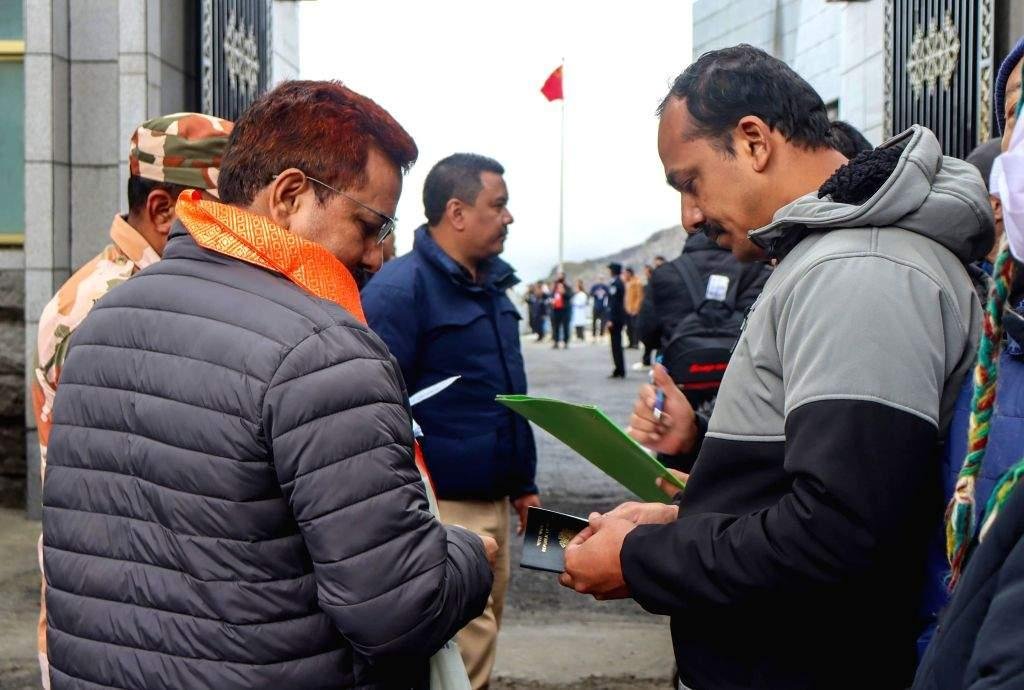
Pilgrims interested in undertaking this journey must submit their applications through the official portal: Official Website: www.kmy.gov.in – Kailash Mansarovar Yatra Registration
The general application and selection process involves the following steps:
💫Step 1: Online Application
Visit the official KMY website and complete the online application form. Applicants must provide accurate personal details, passport information and other requested information.
💫Step 2: Select Nathu La Route
Applicants can indicate their preference for the Nathu La route in Sikkim. The official application process allows applicants to indicate preferences for both government routes.
💫Step 3: Computerised Selection
The selection of pilgrims is conducted through a computerised draw of lots, subject to the official eligibility conditions and available batch capacity. Submission of an application does not guarantee selection.
💫Step 4: Confirmation and Payment
Selected applicants receive instructions regarding confirmation deposits, medical examinations and other payments. The prescribed amount must be paid within the official deadline.
💫Step 5: Medical Examination
Selected pilgrims must undergo the mandatory medical examinations at the designated medical facilities in Delhi and at the prescribed high-altitude checkpoints.
💫Step 6: Final Documentation and Briefing
Before departure, pilgrims complete the required documentation and attend the official briefing organised by the Ministry of External Affairs. Registration dates, selection procedures and batch numbers are announced separately for each pilgrimage season.
Eligibility Criteria for Kailash Mansarovar Yatra via Nathu La
The Government of India has established eligibility requirements to ensure that pilgrims can safely undertake this high-altitude journey.
💫The published government eligibility conditions include:
- Applicant must be an Indian citizen.
- Applicant must hold an ordinary Indian passport.
- The age requirement is generally 18–70 years as specified in the annual guidelines.
- Applicant must be physically fit and medically healthy.
- Applicant must successfully complete the prescribed medical examinations.
- Applicants must meet the passport validity requirements announced for the particular year.
Foreign passport holders and OCI cardholders are not eligible for the MEA-organised government pilgrimage. Medical fitness is especially important because the journey involves travelling through areas located above 4,000 metres, with the Kailash Parikrama reaching an altitude of approximately 5,630 metres at Dolma La Pass. For the latest conditions, refer to the official MEA eligibility guidelines and the annual KMY information booklet.
Documents Required for Nathu La Kailash Mansarovar Yatra
Pilgrims should prepare the documents requested by the government before submitting their application.
💫The commonly required documents and formalities include:
- Original valid Indian passport.
- Recent passport-size photographs.
- Passport photocopies and scanned copies.
- Completed online application.
- Required declarations and undertakings.
- Medical examination reports as instructed by the authorities.
- Other visa and travel documents requested during the official process.
Additional undertakings may include consent and indemnity documents relating to medical emergencies and other contingencies. The final document checklist should always be taken from the current year’s official information booklet.
What Is the Cost of Kailash Mansarovar Yatra via Nathu La?
- The cost of the Nathu La pilgrimage is determined annually by the Government of India and the concerned logistical service provider, Sikkim Tourism Development Corporation (STDC).
- Unlike a regular private tour package, the government programme has a defined fee structure covering various services on the Indian and Tibetan sides.
💫The major expenses generally include:
- STDC logistical and service charges.
- Return air travel between Delhi and Bagdogra, as arranged under the programme.
- Medical examination charges.
- Chinese visa and permit-related expenses.
- Accommodation and meals.
- Transportation on the Indian and Tibetan sides.
- Local support and other prescribed services.
2026 official fee reference: The MEA portal’s published fee table lists ₹5,000 as the STDC confirmation amount, ₹39,000 as the STDC balance payment, ₹21,000 for the Delhi–Bagdogra–Delhi return airfare arranged through STDC, ₹5,500 for medical tests and ₹2,500 for a stress echocardiogram if advised. These are individual listed components, not necessarily the complete final pilgrimage expenditure. Tibetan-side expenses and other applicable charges must also be considered.
Pilgrims should check the latest official fee schedule before making financial arrangements. Do not rely on old package prices or unofficial estimates.
Kailash Parikrama – The Spiritual Highlight of the Journey
The Kailash Parikrama is the most spiritually significant part of the entire pilgrimage. Devotees walk around the sacred mountain as an expression of their devotion to Lord Shiva.

The traditional outer Parikrama covers approximately 52 kilometres and is generally completed over three days.
💫Day 1: Darchen to Dirapuk
The journey starts at Darchen. Pilgrims travel towards Yam Dwar, where the trekking section begins. The route continues towards Dirapuk, offering magnificent views of Mount Kailash.
💫Day 2: Dirapuk to Zuthulpuk
This is the most difficult day of the Parikrama. Pilgrims cross Dolma La Pass at approximately 5,630 metres and descend towards the Zuthulpuk region. The trail includes steep sections and requires considerable physical endurance.
💫Day 3: Zuthulpuk to Darchen
The final trekking section takes pilgrims through beautiful mountain valleys before they reach the designated pickup point and return to Darchen. The Nathu La route reduces the trekking required to reach the Kailash region, but it does not eliminate the Parikrama. Pilgrims unable to complete the trek should discuss suitable alternatives with the official authorities and medical team.
Lake Mansarovar – A Sacred Destination for Hindu Pilgrims
- Lake Mansarovar is among the holiest lakes in the world and is closely associated with Lord Shiva and Lord Brahma.
- Situated at approximately 4,590 metres above sea level, this sacred lake is an important destination for pilgrims visiting Mount Kailash.
- Visitors traditionally offer prayers, meditate and perform religious rituals according to their beliefs. The surrounding mountains and peaceful atmosphere create an unforgettable spiritual experience.
- However, activities such as bathing in the lake, entering the water or collecting lake water should never be assumed to be permitted. Pilgrims must follow the current instructions issued by the Chinese authorities and their designated guides.

Best Time for Kailash Mansarovar Yatra via Nathu La
The official pilgrimage is generally organised during the summer months, usually between June and August or September, depending on the annual programme.
- June: The beginning of the main travel season, with cold conditions at higher elevations.
- July: A popular period for pilgrimage, with relatively favourable summer conditions.
- August: Another important month for group departures, although weather can be unpredictable.
- September: Conditions become colder, particularly in the higher-altitude regions.
The final travel dates depend on government announcements, border permissions and weather conditions.
Medical Preparation and Safety Guidelines
The Nathu La route is comparatively less demanding in terms of approach trekking, but the high altitude makes medical preparation essential.
💫Pilgrims should follow these recommendations:
- Start daily walking and light cardiovascular exercises at least 2–3 months before departure.
- Consult a qualified doctor before applying.
- Complete all government-mandated medical tests.
- Follow the acclimatisation schedule without skipping rest days.
- Carry personal medicines and medical prescriptions.
- Drink sufficient water and avoid excessive physical exertion.
- Carry warm clothing, thermal wear, gloves and comfortable shoes.
- Report headaches, nausea, dizziness or breathing difficulties immediately.
- Follow the instructions of the Liaison Officer and medical personnel.
High-altitude sickness can affect even physically active individuals. Medical fitness does not completely eliminate the risk, and emergency descent may be necessary.
Difference Between Nathu La and Lipulekh Routes
Both routes are official Government of India pilgrimage routes, but their geographical conditions and travel experiences are different.
| Particulars | Nathu La Route | Lipulekh Route |
|---|---|---|
| Indian State | Sikkim | Uttarakhand |
| Starting Point | Delhi | Delhi |
| Indian Logistics | STDC | KMVN |
| Border Crossing | Nathu La Pass | Lipulekh Pass |
| Approach Journey | Mostly by road | Road and trekking |
| Trekking Difficulty | Less approach trekking | More demanding approach |
| Main Trekking | Kailash Parikrama | Kailash Parikrama and approach trekking |
| Duration | Approximately 22–23 days overall | Approximately 23–25 days overall |
- The Nathu La route may suit pilgrims who prefer a more road-oriented journey, whereas the Lipulekh route offers a different Himalayan travel experience with more demanding trekking.
- The exact duration and trekking distances depend on the current official itinerary and operational arrangements.
Why Choose Kailash Mansarovar Himalayas?
- At Kailash Mansarovar Himalayas, we understand that visiting Mount Kailash is not an ordinary holiday but a deeply meaningful spiritual aspiration.
- Our team helps pilgrims explore different Kailash Mansarovar travel options, understand the available routes and prepare for their journey.
💫We provide information and assistance regarding:
- Government and private Kailash Mansarovar pilgrimage options.
- Kailash Mansarovar packages via Nepal.
- Helicopter and overland pilgrimage arrangements.
- Travel planning and itinerary guidance.
- Accommodation and transportation information.
- Documentation and pre-travel preparation.
Important clarification: The official Nathu La MEA pilgrimage can only be applied for through the Government of India’s prescribed process. We do not claim to issue government-route registrations, influence the selection lottery or guarantee a government pilgrimage seat. If you are planning to visit Mount Kailash and Lake Mansarovar, our travel experts can help you understand the available alternative pilgrimage packages and travel arrangements.
Plan Your Sacred Kailash Journey
Kailash Mansarovar Himalayas I A Journey Beyond Faith
- 🚩Kailash Mansarovar Yatra 2027 Booking
- 🌐Website: https://kailashhimalayas.com
- 📞Contact: +91-8090767908
- 📩Email: kailashmansarovar19@gmail.com

Contact our travel experts for Kailash Mansarovar package information and travel guidance.
Frequently Asked Questions (FAQs)
💫1. Is Kailash Mansarovar Yatra via Nathu La an official Government of India route?
Yes. The Nathu La route in Sikkim is one of the two official routes organised by the Ministry of External Affairs, Government of India, in coordination with the concerned Indian and Chinese authorities.
💫2. How many days does the Nathu La Kailash Mansarovar Yatra take?
The overall pilgrimage generally takes approximately 22–23 days, including Delhi reporting, medical examinations, documentation, travel through Sikkim and Tibet, and the return journey. The duration can change according to the annual schedule.
💫3. Can private travel agencies arrange the Nathu La government route?
No. The official Nathu La pilgrimage is organised through the MEA application and selection process. Private agencies cannot independently issue registrations or guarantee seats on this government route.
💫4. What is the age limit for the Nathu La Kailash Yatra?
The published MEA eligibility guidelines specify an age range of 18 to 70 years. Applicants must also satisfy passport, physical fitness and medical requirements applicable to the relevant pilgrimage year.
💫5. Is trekking compulsory on the Nathu La route?
The approach journey is largely motorable, but the traditional Kailash Parikrama involves approximately 52 kilometres of trekking over three days. Therefore, pilgrims should be prepared for strenuous high-altitude walking.
💫6. What is the total cost of the Nathu La Kailash Mansarovar Yatra?
The total cost varies each year. It includes STDC charges, air travel, medical tests, accommodation, transportation, meals and Tibetan-side expenses. Check the official MEA fee structure for the applicable year.
💫7. Can senior citizens undertake the Nathu La route?
Senior citizens who satisfy the official age and medical requirements may apply. However, travelling at high altitude can be challenging, and all applicants must pass the prescribed medical examinations.
💫8. What is the official website for Kailash Mansarovar Yatra registration?
The official government registration portal is https://kmy.gov.in. Applicants should use this website for application announcements, eligibility conditions, selection details and official instructions.
💫9. Is a Chinese visa required for the Nathu La Kailash Yatra?
Yes. The required Chinese visa and travel permissions are processed according to the government-arranged pilgrimage procedure. Selected pilgrims must follow the instructions provided by the MEA.
💫10. Which is better: Nathu La or Lipulekh for Kailash Mansarovar Yatra?
Nathu La is generally more suitable for pilgrims who prefer a largely road-based approach. Lipulekh involves more demanding trekking. Both routes require medical fitness and high-altitude preparation.